Weiss Watch Company Standard Issue Dive Watch Review
The Weiss Watch Company Standard Issue Dive Watch is not a watch you buy to impress the boardroom. It's a watch you buy because you appreciate the idea of an American-made tool watch with a Swiss heart. In a market flooded with mass-produced divers from Switzerland and Japan, Weiss offers something different: a small-batch, Los Angeles-assembled dive watch that feels honest and unpretentious. But is it worth the $2,450 asking price? And more importantly, will it hold its value? Let's dig in.
Brand History: American Independent with Swiss Guts
Weiss Watch Company was founded in 2013 by Cameron Weiss, a watchmaker who trained at the Nicolas G. Hayek Watchmaking School and worked for Audemars Piguet and Vacheron Constantin. The brand is based in Los Angeles, and its mission is to produce high-quality mechanical watches in the United States. The Standard Issue Field Watch was the brand's first model, and it quickly gained a following among enthusiasts who wanted a domestic alternative to Swiss field watches. The Standard Issue Dive Watch is a natural extension of that philosophy, applying the same no-nonsense approach to a dive watch. It uses a Swiss ETA 2824-2 movement, but the case, dial, and assembly are done in the USA. This blend of Swiss reliability and American craftsmanship is the core of the Weiss appeal.
Movement: The Trusty ETA 2824-2
The Standard Issue Dive Watch is powered by the ETA 2824-2, a Swiss automatic movement that needs little introduction. It's a 25-jewel, 28,800 vph workhorse with a 38-hour power reserve. It features hacking and hand-winding, and it's known for its robustness and ease of service. Weiss regulates the movement in-house, but it is not COSC-certified. The movement is not in-house, which may disappoint some purists, but it's a pragmatic choice. The ETA 2824-2 is reliable, accurate, and any competent watchmaker can service it. For a small independent brand, using a proven Swiss movement makes sense. It keeps costs down and ensures that owners aren't stuck with a proprietary movement that requires a trip back to the factory. The finishing is industrial but clean, and you won't see much of it anyway thanks to the solid caseback.
Specs and Design: Classic Dive Watch Formula
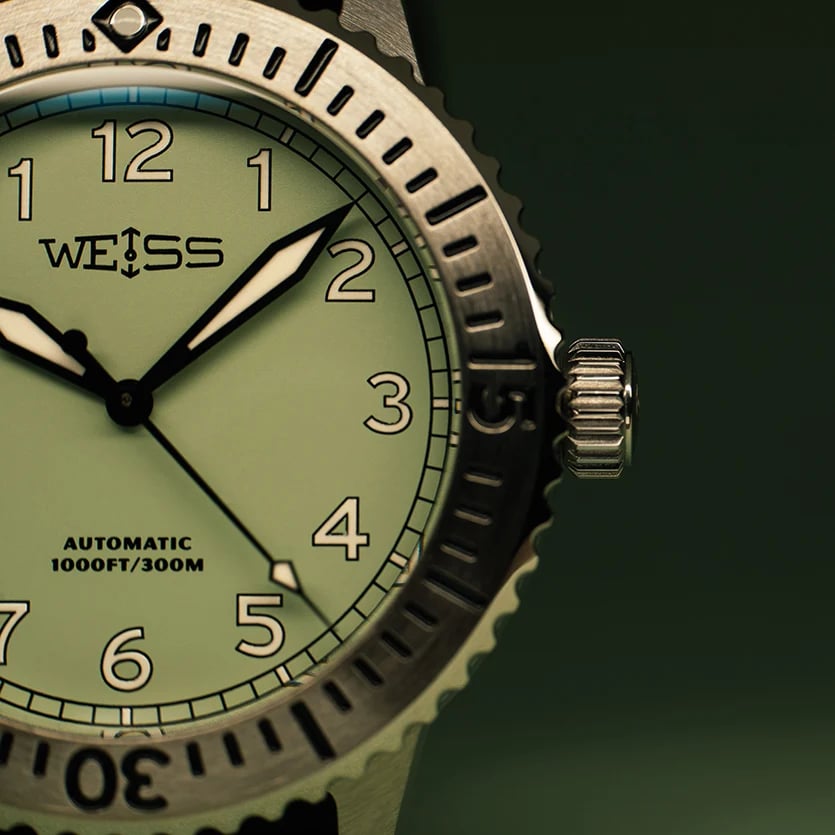
The case is 42mm in diameter, 13.5mm thick, and 50mm lug-to-lug. It's made of stainless steel with a brushed finish. The crystal is sapphire, and the watch is water resistant to 300 meters. The bezel is unidirectional and rotates with 120 clicks. The dial is matte black with Super-LumiNova on the hands and markers. The watch comes on a stainless steel bracelet with a folding clasp. There is no date, which keeps the dial clean and symmetrical. The lume is applied generously, and the markers are large and legible. The overall look is classic dive watch: black dial, white markers, and a sturdy stainless steel case. It's not trying to reinvent the wheel, and that's a good thing.
Wrist Feel: Substantial but Wearable
On the wrist, the Standard Issue Dive Watch feels substantial. The 42mm case has a strong presence, but the 50mm lug-to-lug and curved lugs help it sit comfortably on a variety of wrist sizes. The 13.5mm thickness gives it a bit of heft, but it's not overly tall. The bracelet is comfortable and well-made, with a folding clasp that sits flat against the wrist. The watch feels solid and well-constructed. It's not a lightweight watch, but it's not a brick either. The balance is good, and the watch doesn't feel top-heavy. The bezel action is crisp, and the crown is easy to grip. Overall, it's a watch that you can wear all day without discomfort.
Accuracy: Real-World Performance
The ETA 2824-2 is not COSC-certified, but a well-regulated example should run within -10 to +15 seconds per day. In real-world use, many owners report accuracy in the -5 to +10 seconds per day range. It's not going to win any chronometry contests, but it's perfectly acceptable for a tool watch. The movement is reliable, and with regular servicing, it will last for decades. If you're obsessed with atomic accuracy, you might want to look elsewhere, but for a mechanical dive watch, the accuracy is more than adequate.
Occasions and Wrist Presence
This is a sport watch at heart, but it's versatile enough for daily wear and travel. It's not a formal watch, but it can be worn with smart casual attire. The black dial and stainless steel case are understated enough to fly under the radar. It's not a dress watch, so don't wear it with a tuxedo. But for everything else, it works. On the wrist, it has a presence rating of 4/5. The 42mm case and dive bezel give it a strong wrist presence. It's not oversized, but it's not subtle either. It commands attention without being flashy.
Reference Variants and Family
The Standard Issue Dive Watch is available in a few configurations. The core model has a black dial and a stainless steel bracelet. There is also a version on a rubber strap. The dial is always black, and the case is always stainless steel. There are no limited editions or special colors that we know of. This simplicity is part of the appeal. Within the Weiss family, you'll find the Standard Issue Field Watch, the Automatic Issue, and the American Issue. The Field Watch is a hand-wound, 42mm field watch with an ETA 6497. The Automatic Issue is a more casual automatic watch. The American Issue is a more premium model with an in-house movement. The Dive Watch is the most tool-oriented of the bunch.
Similar Watches and Homages
If you're considering the Weiss Standard Issue Dive Watch, you might also look at the Tudor Black Bay 58, the Omega Seamaster 300M, and the Oris Divers Sixty-Five. The Tudor offers a similar vintage-inspired dive watch with an in-house movement and strong resale value. The Omega is more modern and has a superior movement, but it's also more expensive. The Oris is a more affordable Swiss alternative with a vintage vibe. The Weiss stands out because of its American assembly and independent brand status. If you want the look for less, consider the Seiko SKX007, the Orient Ray II, or the Christopher Ward C60 Trident Pro 600. These watches offer similar dive watch aesthetics at a fraction of the price. They won't have the American-made story, but they are solid tools.
Investment Value: Buy to Wear, Not to Flip
The MSRP of the Weiss Standard Issue Dive Watch is $2,450 on the bracelet. The current retail price is the same. On the secondary market, you can expect to pay between $1,800 and $2,200, depending on condition and accessories. The trend is stable, but it's not appreciating. Independent American brands have a niche following, but liquidity is limited. If you buy this watch, do it because you love it, not because you think it will be a good investment. The hold recommendation is simple: buy it to wear. If you flip it, expect to take a haircut. There is no major auction history for this model.
Service and Maintenance
Weiss recommends regular servicing, but they don't publish a specific interval. The ETA 2824-2 is a common movement, so any qualified watchmaker can service it. You don't have to send it back to Weiss, which is a big plus. Expect to pay a few hundred dollars for a service when the time comes. The movement is reliable, so you shouldn't need to worry about it for several years.
Pros and Cons
- Pros: Made in USA, robust ETA 2824-2 movement, 300m water resistance, clean legible dial, solid bracelet, no-date symmetry.
- Cons: Limited brand recognition, depreciates on secondary market, no date may be an issue for some, not COSC-certified, price is high compared to mass-produced Swiss divers.
Final Verdict
The Weiss Standard Issue Dive Watch is a compelling choice for collectors who value American independent watchmaking and a no-nonsense tool watch. It won't win a spec war against mass-produced Swiss divers, but it offers character, provenance, and a movement that any watchmaker can service. Buy it to wear and enjoy, not to flip. If you want a dive watch with a story and you don't mind the depreciation, this is a solid choice.