The French Horological Renaissance
In the world of luxury horology, the 'Swiss Made' label often acts as a monolithic barrier, overshadowing the rich traditions of other nations. However, for the sophisticated young collector, the real excitement often lies just across the border in Besançon, France. Yema, a brand with a history that rivals the greats of Bienne and Geneva, has undergone a significant transformation over the last decade. The Navygraf Barracuda, reference 21.26.20.66.SNL.D6, is a testament to this revival. It is not merely a reissue; it is a refinement of a 1970s tool watch that was originally designed for professional divers who required absolute legibility and reliability.
Case Architecture: The 47mm Lug-to-Lug Magic
As a reviewer, I am often asked what makes a watch 'wearable.' While diameter is the headline figure, the true secret lies in the lug-to-lug measurement. The Navygraf Barracuda features a 39mm case diameter, which is the contemporary 'sweet spot' for most wrists. But more importantly, its 47mm lug-to-lug distance ensures that the watch remains centered on the wrist. During my week of testing, I found that the watch never 'wandered' or felt top-heavy. The lugs are relatively straight but feature a subtle downward curve that hugs the wrist bone, creating a profile that is both slim (12.15mm) and assertive.
The finish of the case is a brushed 316L stainless steel, which is the correct choice for a daily-wear tool watch. It hides the inevitable scratches of daily life—the 'desk diving' marks from laptop edges and the accidental bumps against doorframes. The crown is a screw-down variety, deeply knurled for easy operation even with damp fingers, and it seats firmly with a reassuring sense of gasket compression.
The Dial: A Study in High-Contrast Legibility
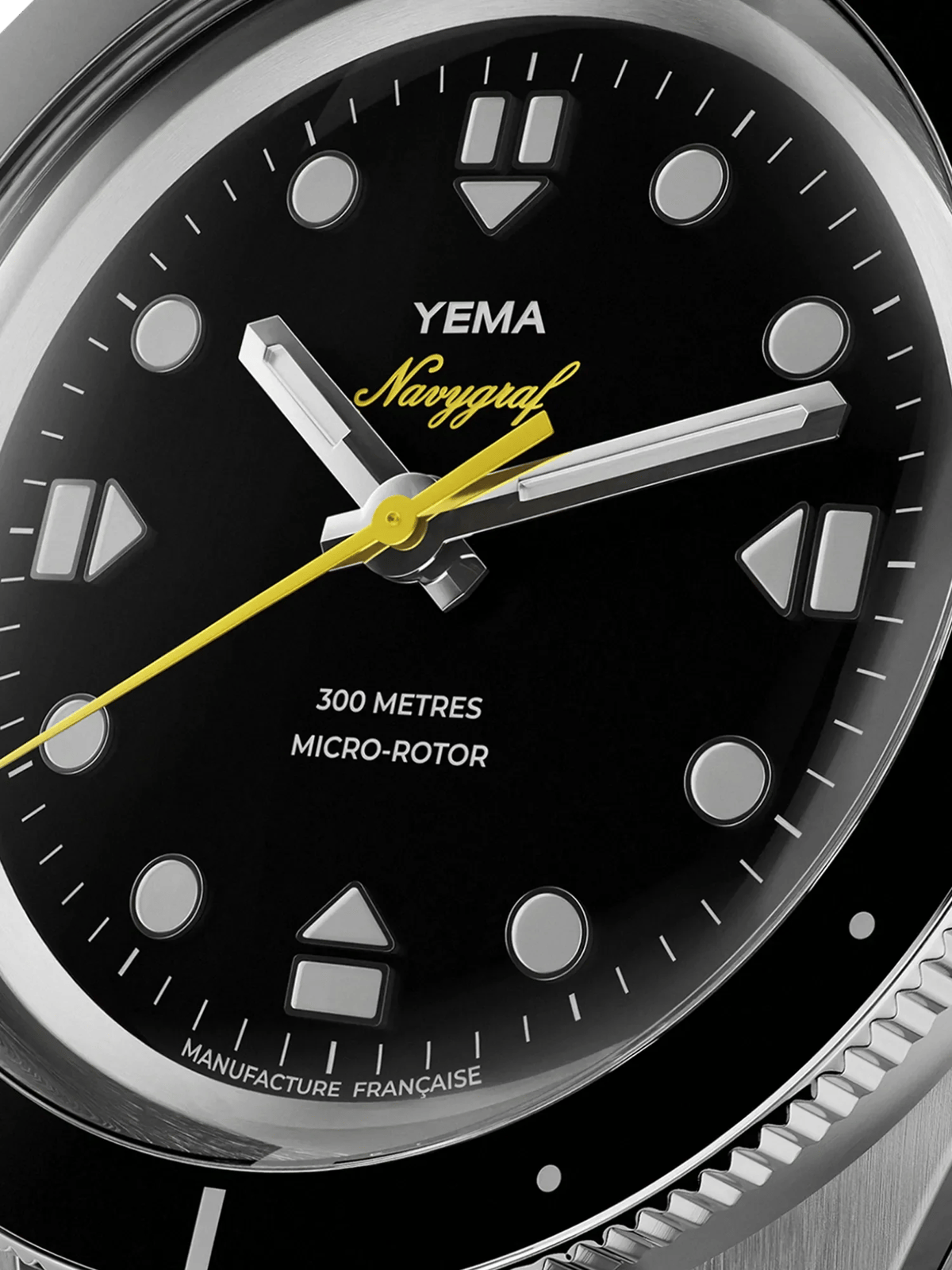
The 'Barracuda' moniker refers to the specific dial layout characterized by its matte black finish and vibrant yellow/orange accents. The indices are what collectors call 'exclamation points'—elongated batons at the cardinal hours that provide instant orientation. The use of Super-LumiNova C3 ensures that the watch remains legible in low-light conditions, glowing with a strong green hue that lasts well into the early hours of the morning.
What I appreciate most about the dial is its lack of a date window. By removing the date complication, Yema has achieved a perfect symmetry that is rare in modern divers. It reinforces the 'tool' nature of the watch; this is a device for measuring time underwater or during a commute, unburdened by the clutter of a calendar. The sapphire bezel insert is another highlight, providing a glossy depth that contrasts beautifully with the matte dial while offering scratch resistance that traditional aluminum inserts lack.
The YEMA2000 Caliber: Independence in the Jura
One of the most compelling arguments for the Navygraf Barracuda is the movement. While many competitors at this price point rely on the ubiquitous Sellita SW200 or Seiko NH35, Yema has invested heavily in its own proprietary caliber, the YEMA2000. This is an 'In-House' movement in the sense that it was designed and is assembled by Yema in France, utilizing a supply chain that emphasizes regional independence.
Technically, the movement is a workhorse. It beats at 28,800 vibrations per hour, providing a smooth sweep of the seconds hand. The 42-hour power reserve is standard for this class, though I would have loved to see it pushed to 60 or 70 hours to survive a full weekend off the wrist. However, as a daily wearer, this is a moot point. The winding action is tactile and audible, a reminder of the mechanical heart beating beneath the steel case back.
A Week on the Wrist: From the Office to the Coast
Monday through Friday, the Navygraf Barracuda lived on its H-link stainless steel bracelet. The bracelet is a highlight of the package—solid end-links, a comfortable taper, and a brushed finish that matches the case perfectly. It felt secure during a frantic morning at the Vivir offices and didn't pinch or pull during long typing sessions. The only minor gripe is the 19mm lug width. While it creates a beautiful visual taper, it does mean that your existing collection of 20mm NATO straps won't fit. You will need to invest in Yema-specific straps if you want to change the look.
On Saturday, I took the watch to the coast. The 300m water resistance meant I had zero hesitation taking it into the surf. The bezel action is 120-click unidirectional, and while it is slightly stiffer than a Submariner's, it is precise with no back-play. The yellow accents on the hands and indices pop brilliantly under the sunlight, making it one of the most legible divers I've ever tested in bright conditions.
The Competitive Landscape
In the sub-$1,000 category, the competition is fierce. The Baltic Aquascaphe offers a similar French vintage vibe but uses a Miyota movement. The Seiko SPB series offers incredible heritage but often suffers from QC issues like misaligned bezels—something I did not find on the Yema. The Barracuda sits in a unique position: it feels more 'boutique' and artisanal than a Seiko, yet more robust and 'military-spec' than a Baltic. For a young collector, it represents a path away from the obvious choices, showing an appreciation for French engineering and specific historical design cues.
Final Verdict: The Daily Driver
The Yema Navygraf Barracuda ref. 21.26.20.66.SNL.D6 is a watch that succeeds because it knows exactly what it wants to be. It doesn't try to be a dress watch, yet its restrained 39mm proportions allow it to function in professional settings. It doesn't try to be a revolutionary piece of tech, yet its in-house movement provides a level of 'horological street cred' that standard ETA-based watches lack.
If you are looking for a watch that can survive a real week on the wrist—from the boardroom to the beach—and you value a story that isn't told in every airport duty-free shop, the Barracuda is a stellar choice. It is comfortable, legible, and possesses a specific French 'je ne sais quoi' that makes it a joy to check the time, even when you're not in a rush.