A Service Record, Not a Marketing Device
Yema is one of the very few brands still able to make the claim that its dive watches were once drawn from naval stores rather than from a display case. Through the 1950s, 1960s and 1970s the Morteau house supplied the French Navy and the French Air Force with chronographs and dive watches, and the Navygraf name descends directly from that period of service issue. The modern Marine Nationale GMT is not a reissue in the sentimental sense. It is a contemporary tool watch built under a formal partnership with the Marine Nationale, which is a materially different thing from licensing a logo and printing a certificate.
The result is a steel dive watch with a 300-metre rating and a fourth hand for a second time zone — a combination that sounds obvious until you try to buy one. The market offers plenty of GMTs and plenty of divers; it offers surprisingly few watches that do both credibly at a price a young collector can defend to a partner. That gap is precisely where this Yema sits.
Yema and the Marine Nationale: A Short Lineage
Henry-Louis Belmont founded Yema in 1948 in Morteau, in the Doubs department of eastern France, a few kilometres from the Swiss border and squarely inside the historic French watchmaking belt. The brand's military work came early and lasted decades. The Superman, with its distinctive bezel-locking crown, and the Navygraf, a compact dive watch with a highly legible dial, both emerged from that environment of specification-driven design.
The Marine Nationale relationship was revived in the modern era as a formal collaboration rather than a heritage claim, and the watches that followed carry the naval association on the dial in the form of the Marine Nationale marking. What matters for a collector is that this is a working partnership: the brand is not merely quoting its own archive, it is currently supplying an institution whose requirements have not softened.
The GMT variant extends the Navygraf brief in a direction that naval service actually demands. A ship's company operates across time zones; a watch that tracks home port alongside local time is not a luxury in that context. It is a piece of equipment.
Case and Crystal: The Tool Watch Contract
The case is 316L stainless steel, brushed on the flanks and on the tops of the lugs, with a polished bevel that catches light along the caseband without drawing attention to itself. The architecture is unapologetically functional: a steeply sloped bezel, a pronounced crown guard assembly, and a screw-down crown large enough to grip and turn with wet or gloved fingers. The 300-metre water resistance rating is stated plainly and backed by the construction rather than by a marketing slide.
The bezel action deserves specific comment. There is no perceptible play at the index, the click is positive and evenly spaced around the full rotation, and the insert aligns precisely with the dial markers at twelve. These are small things individually. Together they are the difference between a watch that feels specified and a watch that feels assembled.
The crystal is sapphire, flat enough to keep reflections manageable and clear enough that the dial reads without effort at arm's length. The caseback is solidly executed and sits flat against the wrist, which is the correct decision on a dive watch and one that keeps the centre of mass low — a detail that matters more to comfort than any dimensional figure on a spec sheet.
The Dial: Legibility as Doctrine
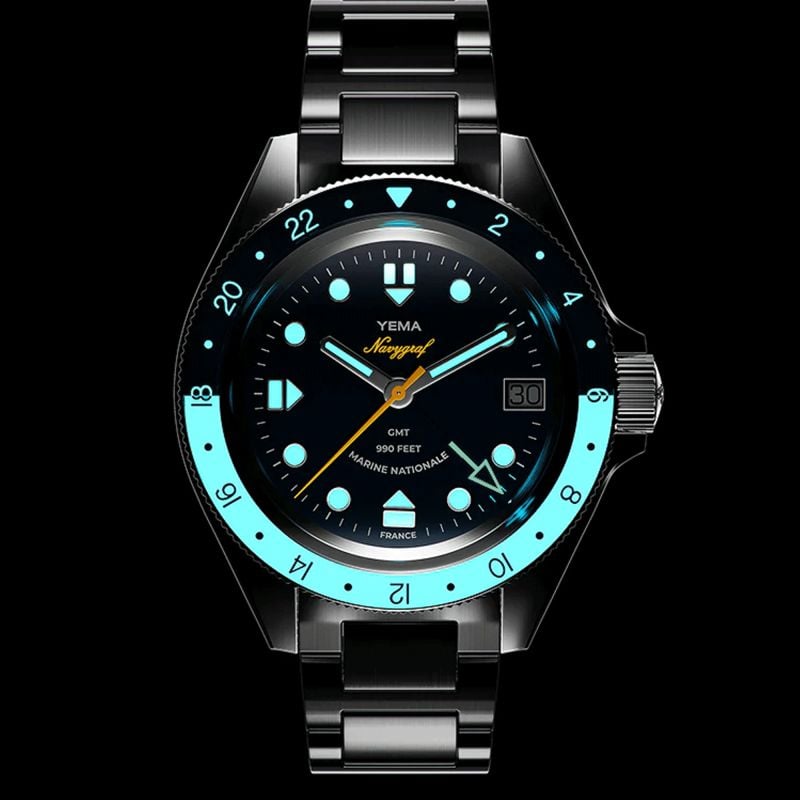
The dial is a deep blue, matte rather than sunburst, which is the right call: a dive watch should not change character as the light moves across it. Applied hour markers sit proud of the surface and carry generous plots of Super-LumiNova, with the twelve position marked by a doubled or triangular index for instant orientation. The hands are broad, sword-shaped and fully lumed, with a clear hierarchy between hour and minute that survives a glance in poor light.
The GMT hand is the one concession to colour, differentiated in a warm accent that separates it cleanly from the local-time hands without shouting. It reads against the dial rather than competing with it — a subtlety many brands miss. The date aperture is present and modest, integrated into the dial furniture rather than punched into it, and the Marine Nationale marking is applied with restraint at the lower half of the dial.
Night-time legibility is where the watch earns its rating. The lume charges quickly under a few seconds of indoor light and holds a useful glow for the better part of a night, with the GMT hand remaining distinguishable from the hour hand at three in the morning — the only test that actually matters.
The Movement: YEMA2000 GMT
Inside sits the YEMA2000 GMT, an automatic calibre assembled by Yema in Morteau and derived from the well-proven ETA 2824 architecture with an added 24-hour train. It runs at 28,800 vibrations per hour, delivers approximately 42 hours of power reserve, and offers hacking, hand-winding, a date and the GMT function. There is no chronometer certification and Yema does not pretend otherwise.
Judged as an object rather than as a specification, the movement is honest. Decoration is industrial — you will find basic finishing and a signed rotor, not Geneva stripes and anglage. That is the correct allocation of resources at this price. The money has gone into the case, the crystal, the bracelet and the water resistance, which are the things you actually touch and rely on. A collector who wants a beautifully finished movement should buy a different watch and pay for it.
The GMT mechanism itself proved stable across repeated setting cycles during the review period, with no backlash in the hand and no drift in the second time zone relative to the main timekeeping.
On the Wrist
The Navygraf wears as a proper dive watch should: substantial enough to register, with a case profile that keeps the mass low and close to the skin. The crown guards give the right flank real presence, and the bracelet's articulation is genuinely good — no sharp edges on the underside, no rattle, and a clasp that closes with a decisive click rather than a hopeful one.
The head sits flat and does not rotate on the wrist, which is the surest sign the caseback shaping has been thought through. On a fabric or elastic parachute strap the watch lightens considerably and takes on a more overtly utilitarian character; this is arguably the more authentic configuration given the Marine Nationale brief, and the one that flatters smaller wrists most.
Accuracy and Ownership
Expect the watch to settle somewhere in the region of minus five to plus ten seconds per day once it has run for a few weeks. Our example trended toward the faster end of that band initially and tightened thereafter, with consistent performance crown-up overnight. That is a realistic standard for an uncertified workhorse calibre, and it is more than adequate for a travel watch where the practical requirement is a reliable second time zone, not a lab figure.
Service intervals of roughly five years are the sensible expectation, at a cost that remains modest by luxury standards. The ETA-derived architecture means independent watchmakers can handle routine maintenance, which is a real advantage for anyone who intends to keep and wear the watch rather than preserve it.
Value, Alternatives and the Verdict
The competition is easy to name and harder to beat. Tudor's Black Bay GMT is the benchmark steel GMT-diver and costs roughly three times as much, with a corresponding jump in case finishing and movement refinement. Longines' Spirit Zulu Time offers COSC certification and a more formal dial but a lower water resistance and a less overtly military character. Christopher Ward's C60 Trident Pro 300 GMT is the closest rival on paper and a genuinely excellent watch, but it lacks the service-derived lineage that gives the Yema its particular gravity.
Yema's own catalogue offers the non-GMT Navygraf Marine Nationale and the Superman GMT as siblings, and the Superman line remains the brand's flagship. Within the Marine Nationale family, the GMT is the most useful watch Yema makes: it does everything the standard diver does and adds a function that earns its place every time you cross a border or take a call from another hemisphere.
The Navygraf Marine Nationale GMT is not a refined object. The finishing is honest, the movement industrial, the case unapologetically a tool. Every one of those characteristics is a decision rather than a compromise, and each one is legible on the wrist. For the collector who wants a steel dive GMT with an actual service record — and who would rather spend the difference on the trip that the second time zone exists to serve — this is close to the correct answer.