Zelos Nova Review: The Microbrand Dress Watch, Refined
Singapore's value specialist proves it can do restraint — and does it with a hand-wound movement.
Zelos Watches has built its reputation on the far side of the dress-watch spectrum: chunky, lume-drenched divers and GMTs with spec sheets that read like a dare. So when Elshan Tang's Singapore outfit turned its attention to a slim, hand-wound, time-only piece with no rotating bezel and no luminous plots to speak of, it read as a quietly contrarian move. The Nova is that watch — a deliberate exercise in restraint from a brand that made its name on abundance.
Microbrand dress watches are a difficult proposition. The category punishes shortcuts. A dive watch can distract with a bold dial and a slab of brushed steel; a dress watch has nowhere to hide, and the finishing of a case flank or the crispness of an applied index is suddenly the whole conversation. The Nova succeeds because Zelos treated it as a machining and finishing problem rather than a styling exercise.
What emerges is a watch that sits comfortably in the space between the serious Swiss dress piece and the affordable everyday watch — a hand-wound, mechanically honest object that asks very little of its owner and gives back a great deal in daily ritual. This is a review for collectors who care about architecture and execution more than badges.
The Brand Behind the Nova
Zelos was founded in Singapore in 2014 by Elshan Tang, an engineer by training who built the company on small-batch releases, aggressive specification and a direct-to-collector sales model that cut out the retail markup entirely. The early catalogue was dominated by dive watches — the Swordfish, the Hammerhead, the Abyss, the Mako — all of them overbuilt in the way enthusiasts adore, with high water resistance, thick sapphire and generous lume.
The Nova is the moment Zelos asked a different question. What if the engineering effort went into thinness and finishing rather than depth and shock resistance? The answer is a watch that shares the brand's value DNA but applies it to a classical brief. It is not a heritage reissue, because Zelos has no heritage to reissue — it is a young brand building a classical vocabulary from scratch, which makes the execution all the more interesting to examine.
Case and Crystal
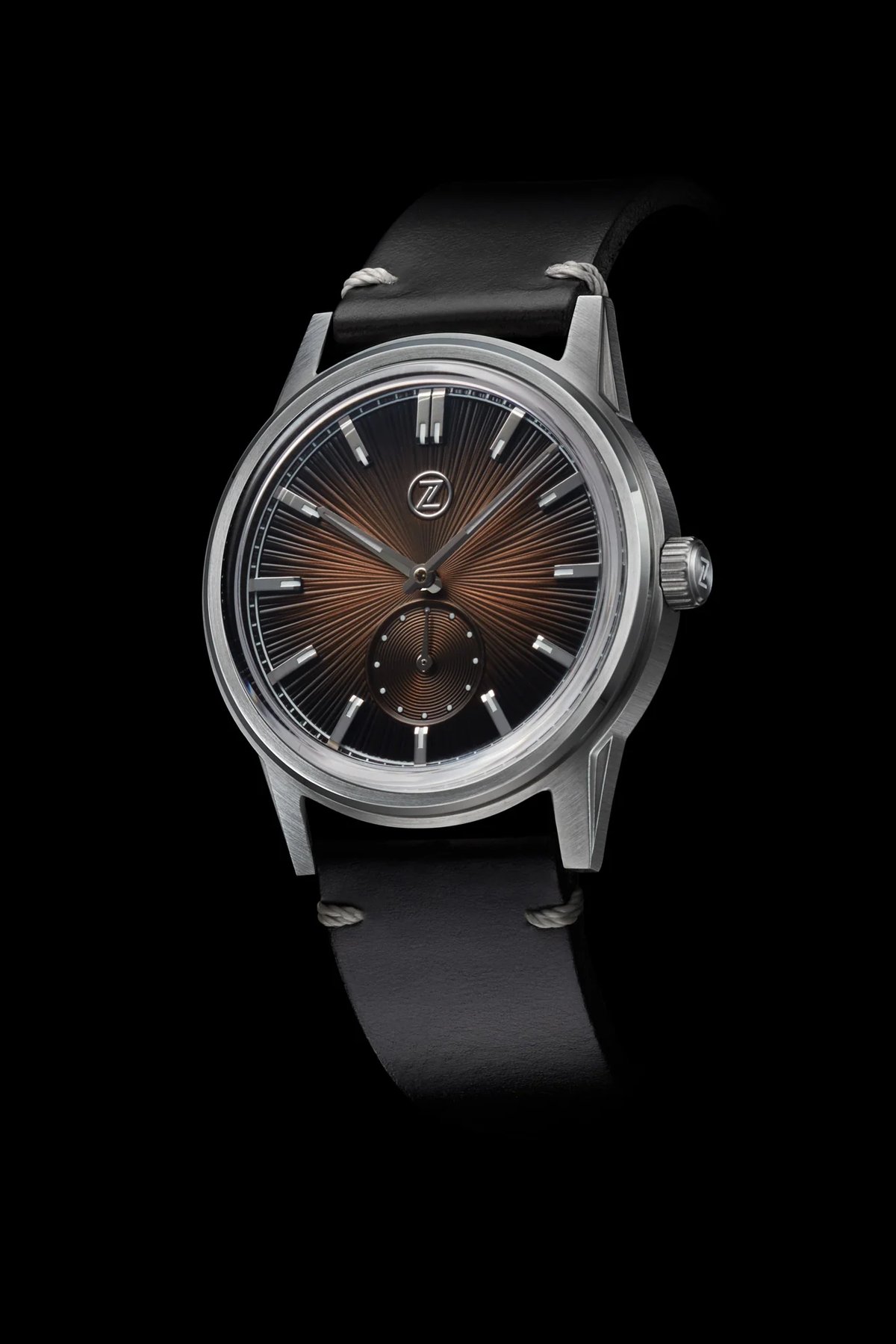
The first thing you notice is how little case there is. Zelos's dive watches are exercises in controlled mass; the Nova is an exercise in subtraction. The mid-case is slender and the bezel is narrow, which pushes the dial outward visually and gives the watch a much larger apparent presence than its physical footprint suggests. The lugs are short and curve downward aggressively, so the case wraps the wrist rather than resting on it — a design decision that pays off handsomely in comfort.
Finishing is where the Nova punches hardest. The case flanks carry a broad satin brush, while the bezel and the lug facets pick up a polished bevel that catches light cleanly along its entire length. It is not hand-finished in the Genevan sense — nobody expects that here — but the transitions between brushed and polished surfaces are sharp and deliberate, without the rounded, washed-out edges that betray cheaper CNC work. The crown is appropriately small and unsigned or lightly signed depending on the batch, and it winds with a firm, positive click rather than the vague mushiness that plagues many entry-level hand-wounds.
The crystal is sapphire and domed, with an anti-reflective coating applied to the underside. The dome is subtle enough that it does not distort the dial at oblique angles, but it does add a warmth that a flat crystal would not. A sapphire crystal at this price point is expected; a well-shaped one is not.
The Dial
The Nova's dial is where the design discipline shows most clearly. It is time-only — no date, no sub-seconds, no power reserve indicator. Two hands and a set of applied indices. That is the entire programme, and it is the right one. A date window on a dress watch at this level almost always looks like an afterthought, and Zelos wisely declined to add one.
The applied indices are faceted and catch the light in a way that flat printed markers never could, and the dial furniture is restrained enough that the surface itself becomes the star. On the plain variants, the dial is a study in subtlety: a fine sunray or a soft matte, depending on the finish, with a printed minute track that is crisp under magnification. On the aventurine variant, the effect is entirely different — a deep blue field scattered with metallic inclusions that sparkle as the wrist moves, giving the watch a nocturnal, almost jewellery-like character. The mosaic mother-of-pearl variant takes the opposite approach, with individual tiles of nacre creating a broken, iridescent surface that shifts colour as you rotate your arm.
Notably, there is no lume. This is a deliberate choice and the correct one: luminous plots on a dress watch are a compromise that serves nobody. If you need to read the time in the dark, this is not the watch for that evening, and Zelos is comfortable saying so.
The Movement
Inside the Nova beats a Sellita SW210-1, a hand-wound calibre derived from the ETA 2801 family. It runs at 28,800 vibrations per hour, carries a power reserve of around 42 hours, and is a thoroughly conventional piece of Swiss industrial watchmaking — which is precisely what you want at this price. Sellita's movements are well understood, widely serviced and easy to source parts for, and the SW210-1 in particular has a reputation for robustness that its price tag does not advertise.
The architecture is a straightforward going train with a conventional winding mechanism. Because it is hand-wound, there is no rotor to obscure the view or to add thickness, and the resulting profile is meaningfully slimmer than an automatic equivalent. Finishing is industrial but tidy: circular graining on the bridges, a light perlage on the mainplate, and polished screw heads. It is not decoration for its own sake — it is the honest presentation of a working movement, and it suits the Nova's restrained character better than an over-decorated calibre would.
The real argument for a hand-wound movement at this level is not specification, it is ritual. Winding the Nova each morning is a small, deliberate act that connects you to the mechanism in a way that an automatic never quite does. Forty-two hours of reserve means you can take it off on Friday evening and find it still running on Sunday morning, which is a more generous margin than many hand-wounds offer.
On the Wrist
The Nova is a watch that disappears on the wrist in the best sense. The case is compact and the profile remarkably slim for a brand so associated with slab-sided divers, and because the lugs curve down sharply from the mid-case, the watch sits flush against the arm rather than perching on top of it. The weight is modest — this is not a piece that announces itself through mass — and the centre of gravity stays low, so there is none of the top-heavy rotation you get when a thick case is paired with a light strap.
On a medium wrist it reads as a proper dress watch, the sort that slips under a shirt cuff without a fight. On a larger wrist it will look slightly precious, and that is a deliberate consequence of the design brief rather than a flaw. The supplied leather is supple and breaks in quickly; the pin buckle is unremarkable but correct, and the strap's taper keeps the visual mass of the case in check. The crown is small but easy enough to grip for daily winding, which is the one ergonomic compromise a hand-wound watch cannot afford to get wrong.
Accuracy in Daily Use
The SW210-1 is not a chronometer-certified movement, and Zelos does not regulate each watch to COSC standards. Expect a break-in period of a few weeks, after which most examples settle into the range of roughly minus ten to plus fifteen seconds per day, with many doing noticeably better. Worn daily and wound each morning, the Nova is entirely usable as an only watch without constant correction; if you need better, a competent watchmaker can regulate it in an afternoon for modest cost.
The hand-wound architecture means you are the power source, so consistency of winding matters more than any specification on paper. Wind it fully at the same time each day and the rate will stabilise accordingly. Let it run down and restart it irregularly, and you will see more variation. That is a characteristic of the breed rather than a defect, and most owners find the routine becomes second nature within a week.
The Nova Lineup
Zelos has released the Nova across several dial treatments, and the choice between them matters more than any specification difference. The Aventurine is the most visually dramatic — a deep blue field with metallic inclusions that turns the watch into something closer to jewellery than tool. The Mosaic Mother of Pearl is the most classically feminine of the range, with individual tiles of nacre creating a broken iridescence that changes with every tilt of the wrist. The Salmon dial is the most traditionally horological option, and arguably the one that best showcases the case finishing and the hand-wound character of the piece.
Because all variants share the same case, movement and crystal, the decision is entirely aesthetic. Collectors who want one dress watch for occasional formal wear should lean towards the plainer dials; those who want the Nova as a daily companion will find the aventurine more rewarding over time, since its character shifts constantly under different lighting.
How It Compares
The obvious benchmark is the Nomos Tangente, the German hand-wound dress watch that has defined the accessible classical category for two decades. Nomos offers in-house architecture, a far higher finishing ceiling and a design language with genuine historical roots — and it costs roughly three times as much. The Nova does not beat the Tangente on any objective measure of watchmaking, but it does deliver a meaningful fraction of the experience for a fraction of the price, and that is a legitimate achievement.
Against the Junghans Max Bill Hand-Wound, the comparison is one of philosophy rather than quality. Junghans offers Bauhaus minimalism and a hand-wound J101 calibre, but the design is so distinctive that it becomes a statement in a way the Nova is not. The Stowa Antea Classic occupies similar territory with a Peseux-based movement, and the Baltic MR01 offers classical proportions with a micro-rotor automatic instead. Each is a valid choice; the Nova's advantage is its combination of slim proportions, applied-index dial and Swiss hand-wound movement at a price none of the others match.
For buyers considering a first serious dress watch, the Nova sits in a useful gap: more refined than the Orient Bambino or the Timex Marlin Hand-Wound, less expensive than anything from Glashütte, and more mechanically interesting than most quartz alternatives at twice the money.
Value and Ownership
Zelos sells direct, which means the price you pay reflects the watch rather than a distributor's margin. At the asking price you are getting a Swiss hand-wound calibre, a sapphire crystal, a well-machined steel case with genuine bevel work, and a dial that punches well above its class. On specification-per-dollar alone, very little in the dress-watch category competes.
Where the Nova is weaker is resale. Microbrand dress watches do not have the collector depth of dive watches, and the secondary market reflects that. Certain dial variants — aventurine in particular — trade near retail because supply was limited, but the broader family will lose value if you buy new and sell quickly. This is a watch to buy and wear for years, not to treat as an asset. Serviceability is a genuine strength: the SW210-1 is one of the most widely understood calibres in production, any competent independent watchmaker can handle it, and complete replacement movements are inexpensive enough that a full service is rarely a difficult decision.
The Verdict
The Zelos Nova is the rare microbrand dress watch that earns its place on merit rather than novelty. Its slim case, disciplined dial and hand-wound Sellita give it a daily tactility that automatic watches at twice the price cannot match, and the finishing is honest work rather than marketing. It will not impress a room, and it was never meant to — it will impress the person wearing it, every morning they wind it.
If you are looking for a first hand-wound watch, a dress watch that does not feel like a costume, or a reminder that mechanical pleasure does not require a five-figure budget, the Nova is one of the most persuasive arguments currently available. Buy the dial that moves you, wind it every morning, and let the rest take care of itself.