The Heritage Trap: Moving Beyond the Movement Provider
For decades, Zenith’s identity was inextricably linked to other brands. Their survival during the quartz crisis and their subsequent resurgence in the 1990s was largely due to the fact that they produced the finest automatic chronograph movement in the world—a movement so good that Rolex used it to modernize the Daytona. This, however, created a 'heritage trap.' For the better part of twenty years, collectors viewed Zenith as a movement manufacturer first and a watch brand second. The 'uncertain future' we discuss today is the brand's attempt to break that cycle.
Under the LVMH umbrella, Zenith has been repositioned. They are no longer content being the supplier; they want to be the protagonist. The Chronomaster Sport, released in 2021, was the opening salvo in this campaign. It was a watch designed to capture the 'Daytona-adjacent' market—those who appreciated the ceramic bezel aesthetic but wanted a movement with more technical flair. But as we move into 2024 and beyond, the market dynamics have shifted. The 'hype' phase of the Chronomaster Sport has ended, and we are now entering the 'value' phase, which is where the true character of an investment is revealed.
The 1/10th Second Proposition: Technical Superiority vs. Market Demand
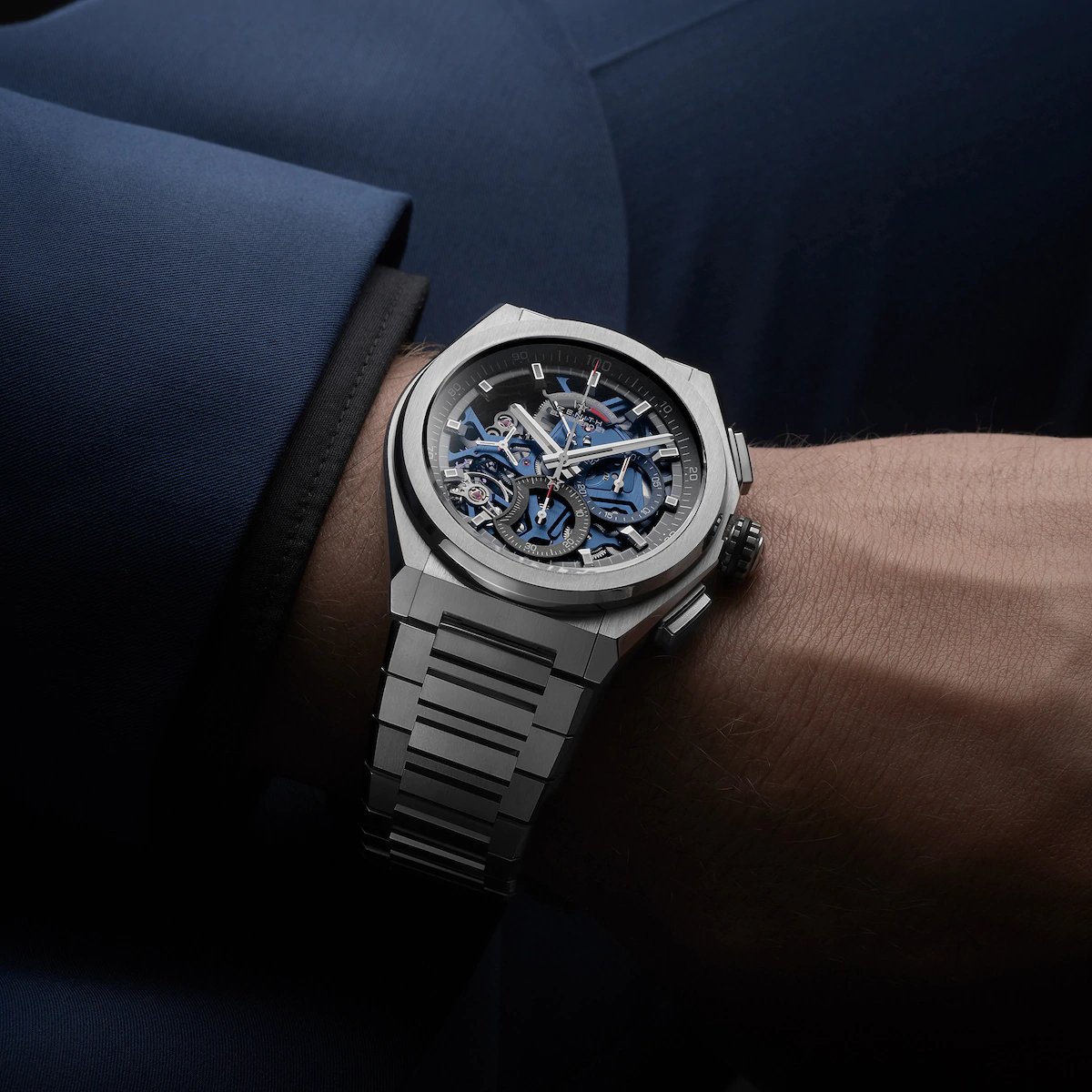
The heart of the current Zenith catalog is the El Primero 3600. It is a technical marvel. By increasing the frequency to 5Hz (36,000 vph) and re-engineering the gear train, Zenith has achieved a 1/10th of a second display that is both visually arresting and mechanically impressive. When you engage the pusher, the central seconds hand flies around the dial once every ten seconds. It is a 'party trick' backed by serious engineering.
However, from an investment perspective, technical superiority does not always equate to value retention. The complexity of the 3600 caliber means that service costs are higher and the pool of qualified watchmakers who can work on them is smaller. For the collector, this introduces a long-term cost of ownership that must be factored into the 'hold' equation. While a Speedmaster or a Daytona can be serviced with relative ease by most high-end independents, the Zenith remains tethered to the manufacture, which gives the brand more control over the secondary market but also increases the friction for the owner.
Resale Data and the Secondary Market Correction
If we look at the numbers, the 'Uncertain Future' of Zenith becomes clearer. At the height of the market in early 2022, the Chronomaster Sport was trading at or slightly above its $11,000 MSRP. Today, the secondary market is awash with examples in the $7,500 to $8,200 range. This represents a nearly 30% drop from retail—a significant hit for any modern collector.
This depreciation is not necessarily a reflection of the watch's quality, but rather of Zenith's aggressive MSRP increases. LVMH has pushed Zenith’s pricing into a bracket where it competes directly with the Rolex Submariner and the Omega Speedmaster 'Ed White.' In this price tier, brand equity is the primary driver of value. Zenith has the history, but it lacks the 'Veblen good' status that prevents price erosion. For the smart collector, this means that the Chronomaster Sport is a terrible 'buy new' prospect but an exceptional 'buy pre-owned' opportunity. The 'uncertainty' lies in whether Zenith can ever bridge the gap between their retail ambitions and their secondary market reality.
The 'Daytona Alternative' Label: A Double-Edged Sword
Critics and enthusiasts alike frequently label the Chronomaster Sport as the 'Zenith Daytona.' While this helped the watch gain immediate traction, it also limits the brand's upside. An alternative is, by definition, a second choice. For Zenith to secure its future, it must move away from being a substitute and become a primary destination. We are seeing attempts at this with the 'Defy' line and the 'Chronomaster Original' series, which leans more heavily into Zenith’s unique 1969 case shapes. These models actually hold their value more predictably because they aren't competing for the same headspace as a Rolex.
The sophisticated collector should look at the Chronomaster Sport not as a Daytona substitute, but as a high-frequency instrument. The 'uncertainty' of the brand's future is actually its greatest asset for the collector: as the brand experiments with its identity, it produces unique, low-production references that may one day be viewed with the same reverence as the 'pre-Daytona' chronographs of the mid-20th century.
Final Judgment: Hold or Sell?
If you purchased a Zenith at retail in the last 24 months, you are likely 'underwater' on the investment. In this scenario, the recommendation is a firm **HOLD**. The quality of the El Primero 3600 ensures that these watches will never become obsolete or worthless. They are foundational pieces of horological history. Selling now would be to realize a loss at the bottom of a market cycle.
For those looking to enter the brand, the 'Uncertain Future' is your best friend. Wait for the secondary market to stabilize further. Look for references with the full kit and remaining warranty. At $7,500, a Chronomaster Sport is perhaps the best value-for-money chronograph on the planet. Zenith’s future may be uncertain in terms of its corporate positioning, but its place in the pantheon of great Swiss watchmakers is secure. Buy the watch for the movement, but time your entry to the market cycle.