In a market that rewards consensus, the Zero G is a reminder that Zenith still knows how to be audacious. This is the watch you wear when you want the people at the table to ask what is going on inside your wrist. It is also the watch you wear when you have stopped pretending that a dive bezel is a personality.
The Defy line and Zenith's engineering habit
Zenith has been making movements in Le Locle since 1865, and its modern identity is inseparable from the El Primero. Launched in 1969, the El Primero was one of the first automatic chronograph calibers and remains one of the few movements that collectors can identify by sound, architecture, and reputation. The Defy line is where Zenith lets its engineering habit run wild. It is the brand's avant-garde platform, the place where materials, shapes, and mechanisms are allowed to be strange.
The Zero G sits at the top of that impulse. Its name is not marketing fluff. The watch contains a regulating organ suspended in a gimbal system designed to keep the balance in a horizontal plane as the wrist moves. The goal is to reduce the effect of gravity on rate stability. It is not a tourbillon, and it is not a conventional automatic. It is a gravity-control system, and it gives the Zero G a mechanical signature that few watches at any price can match. The Defy Lab and Defy Inventor are part of the same family tree, but the Zero G is the version that feels most like a wearable statement.
The movement: El Primero 8812 S
Inside the Zero G is the El Primero 8812 S, an automatic caliber with a 50-hour power reserve and a high-frequency beat of 36,000 vibrations per hour. The high frequency is classic El Primero territory: it gives the seconds hand a smooth, almost liquid sweep and speaks to Zenith's long-standing interest in precision. The 8812 S takes that base and adds the gimballed module, which is the reason the watch exists.
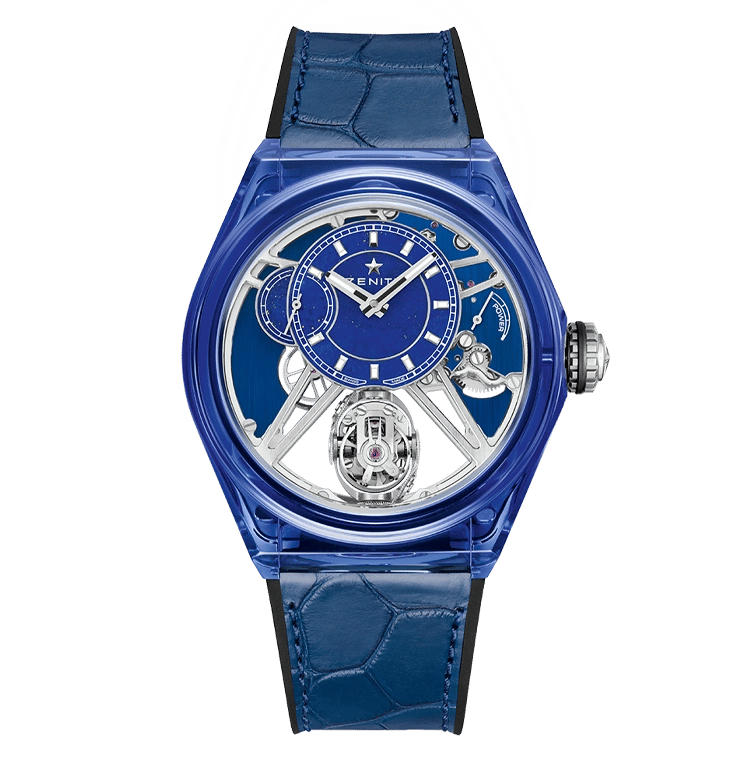
The architecture is openworked and modern. Bridges are cut away, the regulating organ is visible, and the dial is less a reading surface than a stage. This is not a movement with old-world frosting and hand-engraved nostalgia. It is technical, architectural, and slightly aggressive. The finishing is clean and contemporary rather than romantic. You buy this watch because you want to see the mechanism working, not because you want a quiet gold dress watch with a pretty rotor.
The gimbal is the star. As the wrist moves, the module is designed to keep the balance in a consistent plane. That is the promise of gravity control: not that gravity disappears, but that its effect on rate is managed. The result is a watch that feels alive. The motion of the module, the open bridges, and the high-frequency balance create a constant visual hum. It is the kind of detail that makes a dinner conversation last longer than the dessert menu.
Case, bracelet, and wrist feel
The Zero G is a titanium watch, and that matters. Titanium gives the case a cooler, lighter feel than steel, which is welcome because the watch is visually massive. The open dial, the gimballed module, and the integrated-style bracelet all add to the sense of mechanical density. On the wrist, however, the titanium keeps it from feeling like a brick. It wears lighter than it looks, and the bracelet balances the head well. The deployant clasp is secure and appropriate for a watch at this level.
This is not a subtle watch. The skeletonized dial and the blue accents give it a high-contrast, futuristic look. It catches light and attention. The trade-off is legibility. Reading the time is a deliberate act, especially in low light, and there is no lume to rescue you. That is not a flaw so much as a design decision. The Zero G is a mechanical spectacle first and a time-telling tool second. If you need to check the time in a dark cinema, you will be squinting. If you need to make an impression at a collector dinner, you will be fine.
Wrist presence is strong: 4/5. It is not as shouty as a Richard Mille, but it is not discreet either. It sits in the space between high horology and modern sports watch, which is exactly where Zenith wants it. The titanium bracelet gives it a more integrated, contemporary feel than a leather strap would. It feels like a piece of engineering hardware, not a piece of jewelry.
Accuracy and daily expectations
The Zero G is not COSC-certified, and Zenith does not sell it as a chronometer first. The point of the gimballed system is rate stability across positions, not paperwork. In real-world use, a well-regulated high-frequency El Primero should run within a few seconds a day. That is respectable for a mechanical watch, but it is not quartz precision. The gravity-control system is there to manage positional variation, and the high frequency helps with stability. The watch is at its best when you stop obsessing over the daily rate and start enjoying the mechanism.
This is not a daily beater in the traditional sense. It is robust enough for normal wear, but the openworked dial, the specialized module, and the lack of lume make it a watch for deliberate occasions. Wear it to the office if your office is interesting. Wear it to a collector meetup. Wear it on a trip where you want one watch that does the work of a conversation piece. Do not wear it to the gym and expect it to behave like a G-Shock.
Reference and variants
The reference I would focus on is 95.9000.8812/01.M9000, the titanium version with a skeletonized dial with blue accents and a titanium bracelet. It is the cleanest expression of the Zero G idea: lightweight case, integrated bracelet, and a movement that does not need a precious metal case to justify itself. The blue accents give the dial a welcome hit of color without turning it into a fashion piece.
Zenith has not built a sprawling variant catalog around the Zero G, and that is probably wise. This is a halo piece, not a volume model. If you see one in the metal, pay attention to the condition of the bracelet and the service history. The gimballed module is not something you want to discover needs attention after you have already wired the money.
The family tree and the rest of Zenith
The Zero G belongs to the same experimental lineage as the Defy Lab and the Defy Inventor. Those watches pushed materials and oscillator technology in different directions, and they helped establish the Defy line as Zenith's laboratory. The Defy El Primero 21 is the more accessible high-frequency sibling, with a chronograph architecture that is easier to understand at a glance. The Zero G is the one that turns the movement into a spectacle.
Elsewhere in the Zenith catalog, the Chronomaster Sport is the current collector favorite, the El Primero A384 Revival is the vintage-inspired choice, the Defy Skyline is the everyday modern sports watch, and the Pilot Type 20 is the rugged alternative. The Zero G sits above them all as a statement of technical ambition. It is not the watch you buy instead of a Chronomaster Sport. It is the watch you buy after you already understand why the Chronomaster Sport matters.
Similar watches to consider
The obvious comparison is the Ulysse Nardin Freak, another avant-garde regulator with a carousel-style architecture and no traditional dial. The Freak is more radical, and it has a longer history of being strange. The Zero G is more wearable and more clearly a Zenith. The Hublot MP-11 is another movement-first sports watch with a skeletonized layout and a dramatic silhouette. It is louder and more polarizing. The Richard Mille RM 11-03 is the ultimate example of engineering as luxury theater, but it operates in a different price and cultural universe.
If you want the Zero G experience at a lower price, you will not find the gimbal. That is the point. The affordable alternatives are skeletonized automatics that deliver the visual drama without the gravity-control mechanism. Seiko's Presage Skeleton, Tissot's T-Complication Squelette, and Orient's Star Skeleton all give you an open dial and a mechanical movement for a fraction of the price. They are not homages in the strict sense, because none of them replicate the gimbal. They are reminders that the skeleton-dial look is easy to imitate and the engineering is not.
Investment value and secondary market
The Zero G launched at around $95,000, and current retail is around $105,000. Pre-owned examples tend to trade in the $60,000 to $85,000 range, depending on condition, completeness, and service history. That is a meaningful discount, and it tells you something about the market. The Zero G is not a hype watch. It does not have the liquidity of a Nautilus or the auction heat of a vintage Daytona. It is a specialist piece for a collector who wants the mechanism more than the resale story.
The trend is stable rather than appreciating. There is no major auction history to point to, and the secondary market is thin. That is not a reason to avoid the watch. It is a reason to buy it carefully. If you can find a well-documented example at a pre-owned discount, you are getting a lot of high horology for the money. If you are buying it as an investment, you are buying the wrong watch. Hold it because you love the gimbal, the high-frequency movement, and the fact that almost nobody else at the table is wearing one.
Service and ownership
Service should go through Zenith. The gravity-control module is specialized, and this is not a watch you hand to a general watchmaker who mostly does battery changes and bracelet sizing. Zenith recommends service through authorized channels, and the cost will reflect the complexity of the movement. The exact interval depends on wear and the condition of the module, so there is no universal number to quote. The important thing is to keep the paperwork and use an authorized service center. A Zero G without a documented service history is a negotiation, not a bargain.
Price range and verdict
The price range for the Zenith Defy Zero G is roughly $60,000 to $105,000, depending on whether you are looking at pre-owned examples or current retail. At that price, you are paying for a gimballed, high-frequency El Primero in a titanium case, a skeletonized dial that is genuinely unlike anything else in the Zenith catalog, and a conversation piece that does not rely on a logo to do the talking. Value retention is softer than the hype steel icons, so buy the example you love and plan to keep it.
Pros: the gravity-control movement is genuinely rare, the titanium case makes a complex watch wearable, the high-frequency El Primero base is a strong foundation, and the skeletonized dial is a spectacle. Cons: legibility is compromised, specialized service is costly and slow, resale is thin compared with steel sports icons, and there is no lume and no stealth factor.
The final verdict is this: the Defy Zero G is Zenith at its most audacious. It is not the easiest watch to read or the safest place to park capital, but it is one of the most interesting mechanical objects you can strap on. For the collector who wants engineering theater rather than consensus approval, it earns its place. For everyone else, it is a reminder that watchmaking can still be weird, ambitious, and fun.