The Golden Age of the GMT
In the mid-1960s, the world was shrinking. The introduction of the Boeing 707 and the Douglas DC-8 meant that for the first time, humanity could cross oceans in hours rather than days. This seismic shift in travel created a new problem for the elite: 'jet lag' and the need to track multiple time zones. While the Rolex GMT-Master is often credited as the sole solution to this problem, the Zodiac Aerospace GMT ref. 752 was right there in the cockpit, offering a sleeker, more accessible alternative for the professional pilot and the frequent flyer alike.
The Aerospace GMT wasn't just a response to a trend; it was a technical achievement. Zodiac, a brand already respected for its Sea Wolf diver, understood that a pilot's watch needed to be legible, reliable, and—perhaps most importantly—thin enough to not snag on flight equipment. The ref. 752 delivered on all fronts, utilizing a slim automatic movement that allowed for a case profile that remains enviable today.
Design Language: The Bakelite Allure
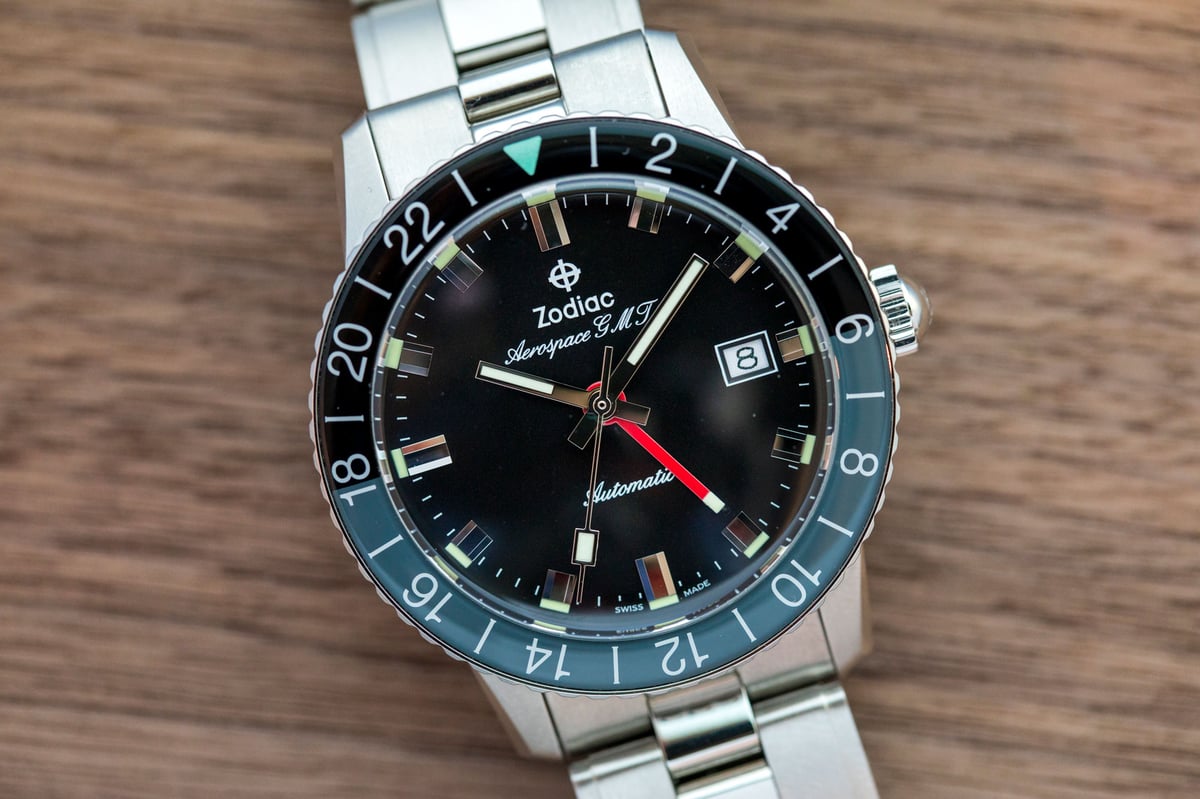
The most striking feature of the Aerospace 752 is undoubtedly its bezel. During this era, Zodiac utilized bakelite (and later acrylic) for their bezel inserts. These bezels possess a depth and gloss that modern ceramic simply cannot replicate. Whether it's the classic grey and black or the rarer 'Pepsi' and 'Sherbet' colorways, the way the light interacts with the material gives the watch a three-dimensional quality.
The dial of the 752 is a study in functional minimalism. Usually found in gloss black or sunburst silver, it features applied baton markers and the iconic 'Zodiac' crosshair logo. The GMT hand is typically a bright, contrasting color—often red or orange—ensuring that the second time zone is readable at a glance. The hands are filled with tritium, which in many surviving examples has aged to a beautiful creamy pumpkin patina, adding to the watch's vintage 'soul.'
The Caliber 70-72: A Workhorse with Pedigree
Inside the ref. 752 beats the Caliber 70-72. This movement is a product of the 'Joint Development' group, a consortium of Swiss brands including Zodiac, Doxa, and Girard-Perregaux. This collaboration was born out of a necessity to compete with the looming threat of quartz and the industrial might of larger firms. The result was a movement that was both high-performing and relatively easy to service.
Technically, the GMT complication in the 752 is a 'caller' GMT. The 24-hour hand is geared directly to the hour hand. To track a second time zone, the wearer rotates the bi-directional bezel until the desired hour aligns with the GMT hand. While 'true' GMTs with independent hour hands are the modern standard, there is a tactile satisfaction in the 752’s mechanical simplicity. It forces a connection between the wearer and the machine.
Wrist Feel and Modern Wearability
We are currently living through a 'size correction' in the watch world. After two decades of 44mm 'dinner plates' on the wrist, the 35mm to 38mm range is seeing a massive resurgence. The Aerospace 752, at 35.5mm, is perfectly positioned for this trend. Because the lugs are relatively long and straight, it wears more like a 37mm watch, providing enough presence to feel substantial without being intrusive.
On the wrist, the watch is incredibly light. If you are lucky enough to find one on its original expansion bracelet, you'll experience the 'stretch' that made these watches so popular with active users in the 60s. However, the 18mm lug width makes it a strap monster. A distressed brown leather strap brings out the warmth of the patina, while a grey suede strap emphasizes the tool-watch heritage.
The Collector's Market: What to Look For
Buying a ref. 752 today requires a discerning eye. The 'Achilles heel' of this reference is the bezel. Bakelite is brittle; over sixty years, many have cracked or chipped. A 752 with a mint, uncracked bezel is the 'holy grail' for Zodiac collectors and commands a significant premium. You should also check the date-set function; the 70-72 uses a semi-quickset method (moving the hands between 8 PM and midnight), which can be damaged if forced by an inexperienced owner.
Despite these caveats, the Aerospace GMT remains one of the best value propositions in vintage horology. While a 1675 GMT-Master will set you back the price of a mid-sized sedan, a beautiful ref. 752 can still be found for under $3,000. It offers 90% of the charm and 100% of the history for a fraction of the cost.
Final Verdict: The Vivir Take
The Zodiac Aerospace GMT ref. 752 is a watch for the individualist. It’s for the traveler who prefers a boutique hotel in the 11th Arrondissement over a sterile luxury chain. It’s a watch that tells the world you value design, history, and mechanical ingenuity over sheer brand recognition. In the landscape of vintage watches, it remains a bright spot of color and character—a true icon of the jet age that is finally getting the respect it deserves.