The Dawn of the 24-Hour Dial
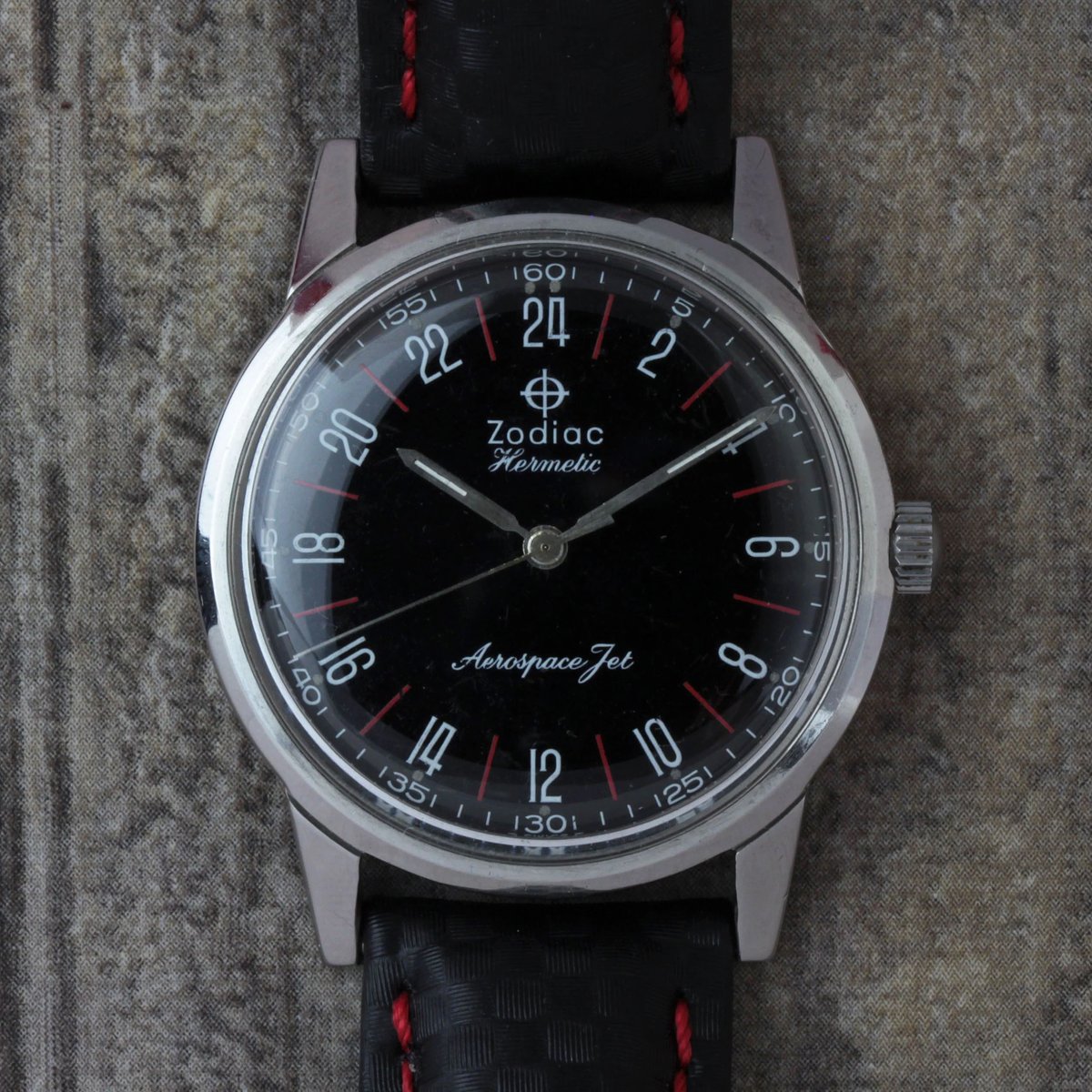
In the hierarchy of mid-century aviation watches, the conversation usually starts and ends with the Rolex GMT-Master. But for those who spent their time in the cockpits of the first commercial jets, the 12-hour clock was an antiquated relic of a slower world. Enter the Zodiac Aerospace Jet Reference 758. Unlike its more famous sibling, the Aerospace GMT, the Jet didn't bother with a rotating bezel. It went straight to the heart of the matter: a 24-hour dial that tracked the day in one continuous sweep.
This wasn't a gimmick. For pilots crossing multiple time zones at 500 miles per hour, the distinction between AM and PM wasn't just a matter of convenience—it was a matter of navigational accuracy. The Ref. 758 was Zodiac's answer to this professional need, a watch that stripped away the maritime heritage of the Sea-Wolf and replaced it with the clinical precision of the aerospace industry.
Design and Aesthetics: The 34mm Paradox
To the uninitiated, the 34mm case of the 758 might seem like a dealbreaker. We live in an era of 42mm 'tool' watches that feel like hockey pucks on the wrist. But the 758 challenges the modern obsession with size. Because the dial takes up almost the entire surface area of the case, the visual impact is far greater than the measurements suggest. The high-contrast white numerals against the deep black dial create a sense of depth that draws the eye in.
The 'Aerospace Jet' branding at 6 o'clock is rendered in a beautiful, era-appropriate script that feels like it belongs on the side of a Boeing 707. The hands are simple, baton-style affairs, often filled with tritium that has, in most surviving examples, aged to a creamy pumpkin patina. It is a masterclass in functional design—nothing is wasted, nothing is purely decorative.
The Engine: Caliber 721
Under the hood of the 758 beats the Zodiac Caliber 721. Based on the venerable A. Schild 1701, this manual-wind movement was modified by Zodiac’s engineers to support the 24-hour display. In a standard watch, the hour hand completes two rotations every day. In the 758, the gearing is halved, allowing for a single, majestic 24-hour cycle. This modification is simple but profound, altering the fundamental way the wearer perceives the passage of time.
Winding the 758 is a tactile joy. The crown is small but grippy, and the click of the ratchet is a reminder of a time when watches required daily interaction. It’s a mechanical ritual that connects you to the pilots of the 1960s who performed the same task before takeoff.
Why it Matters Today
In the current watch market, 'authenticity' is the most overused word in the dictionary. Every brand is digging through their archives to find a story to tell. But Zodiac doesn't have to dig. The 758 is a genuine artifact of a specific cultural moment. It represents the optimism of the 1960s—the belief that technology could shrink the world and that time itself could be mastered.
For the collector, the 758 offers something that a modern Tudor or Omega cannot: a sense of discovery. It is a watch that requires you to explain it. When someone asks why your hour hand is pointing at the bottom of the dial at 1:00 PM, you aren't just telling them the time; you're telling them a story about the Jet Age.
The Vivir Verdict
The Zodiac Aerospace Jet 758 is not for everyone. It’s not for the person who wants a status symbol that everyone recognizes from thirty feet away. It’s for the collector who values the 'IYKYK' (If You Know, You Know) factor. It’s for the person who appreciates the nuance of a 24-hour dial and the charm of a 34mm case. At its current price point, it is one of the last remaining 'affordable' icons of vintage horology. If you find one with a clean dial and a sharp case, don't hesitate. The world is moving fast, and these jets won't stay on the ground for long.