The Resurrection of a Celestial Icon
To understand the Zodiac Astrographic, one must first understand the era of its inception. In 1969, the world was obsessed with the horizon—specifically, the one beyond our atmosphere. This cultural fascination permeated every facet of design, from the curves of the Eero Aarnio Ball Chair to the sleek, lugless silhouettes of horology. The Astrographic was Zodiac's answer to this futurist call, a watch that appeared to defy the laws of physics by suspending its hands in mid-air.
The reference ZO6606 is not merely a facsimile of that original vision; it is a refined evolution. As a limited edition celebrating the 50th anniversary of the model, it carries the weight of history while benefiting from five decades of metallurgical and mechanical progress. For the sophisticated young collector at Vivir, this watch represents a departure from the ubiquitous dive watches that dominate the landscape, offering instead a conversation about geometry, light, and the 'mystery' of time itself.
Case Architecture and Finishing
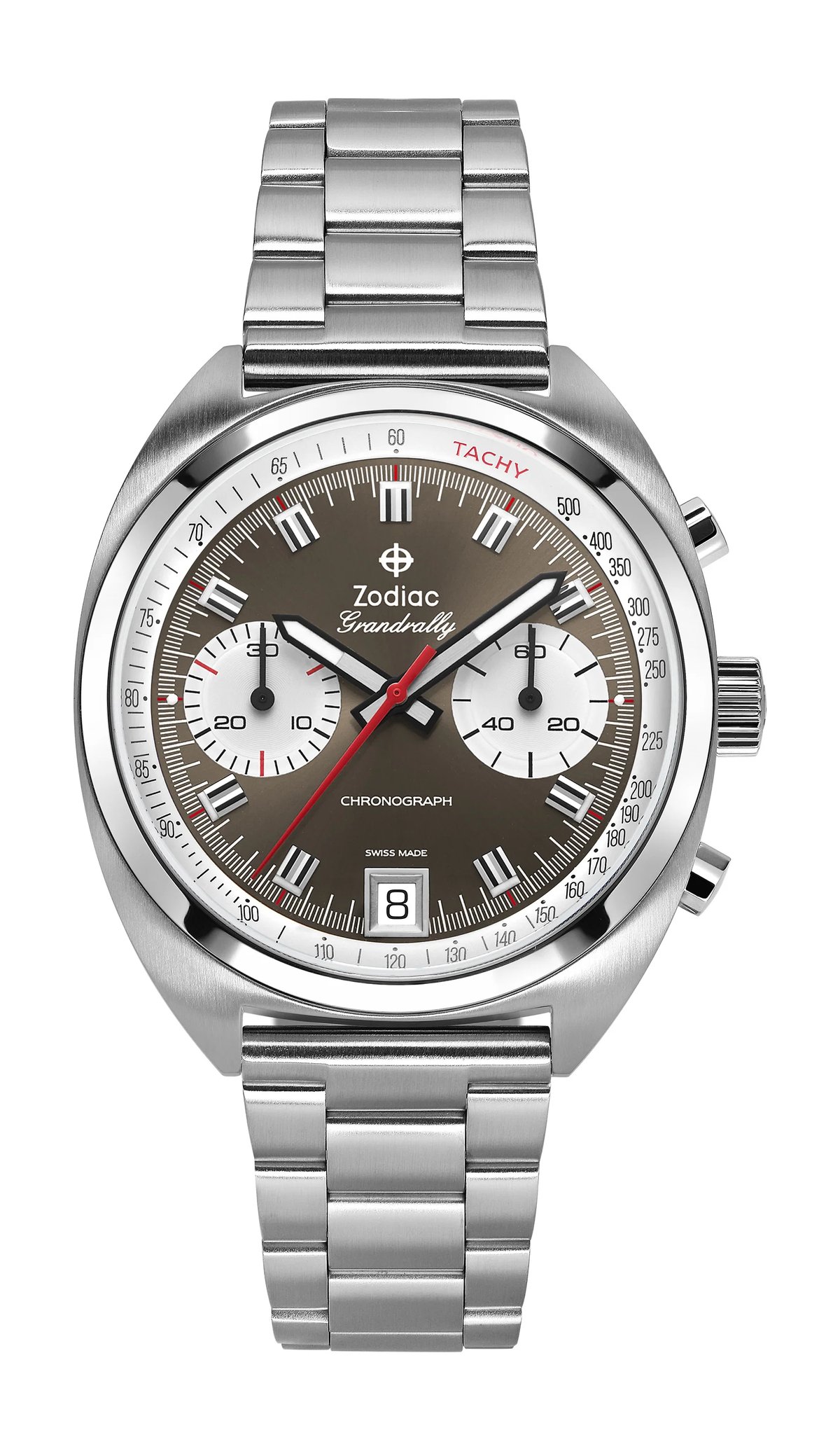
The case of the ZO6606 is a masterclass in the 'cushion' or 'barrel' shape that defined the late 60s and early 70s. Measuring 40mm in width and 43mm from top to bottom, it occupies a sweet spot on the wrist. The finishing is predominantly brushed, with a fine vertical grain that catches the light in a way that emphasizes the watch's tool-like origins despite its whimsical dial. This brushing is contrasted by sharp, polished chamfers along the edges, providing a necessary hint of luxury that elevates the piece from a mere novelty to a serious horological instrument.
What is particularly impressive is the integration of the sapphire crystal. In the original 1969 models, mineral glass or acrylic was used, which often suffered from clarity issues. The ZO6606 utilizes a flat sapphire crystal with multiple layers of anti-reflective coating on the underside. This is crucial for a mystery dial; any glare would immediately shatter the illusion of the floating hands. The crystal sits nearly flush with the bezel, maintaining a sleek profile that slides easily under a bespoke shirt cuff.
The Mystery Dial: A Technical Deep Dive
The 'Mystery Dial' is the raison d'être of the Astrographic. To achieve this effect, Zodiac utilizes three transparent acetate discs. The innermost disc tracks the hours, the middle disc tracks the minutes, and the outermost disc—the most captivating of all—features a small red dot that orbits the dial to track the seconds. This red dot, often referred to as 'the satellite,' provides a kinetic energy that is rare in watches at this price point.
Technically, the use of discs presents a unique set of challenges for the movement. A traditional hand-stack is lightweight and perfectly balanced. Discs, however, possess significantly more mass and surface area, which increases friction and requires higher torque from the movement to maintain a consistent amplitude. Zodiac’s choice of the STP 1-11 movement is strategic here. The movement is essentially a modified clone of the ETA 2824-2, known for its robust mainspring and high-torque delivery. By regulating this movement to handle the specific inertia of the Astrographic’s discs, Zodiac ensures that the watch remains an accurate timekeeper despite its visual complexity.
The STP 1-11: Industrial Precision
While some purists may clamor for a fully in-house caliber, the STP 1-11 (manufactured by Swiss Technology Production, which, like Zodiac, is under the Fossil Group umbrella) is a formidable engine. It beats at 28,800 vibrations per hour (4Hz), providing that smooth, sweeping motion of the red satellite dot. The finishing on the movement, visible through the exhibition caseback on some variants (though the ZO6606 features a commemorative solid caseback for historical accuracy), includes perlage on the plates and a custom rotor with the Zodiac logo.
From a serviceability perspective, the STP 1-11 is a dream for the collector. It avoids the 'black box' servicing trap of many high-end manufactures. Any skilled horologist can regulate or repair this movement using standard parts, ensuring that the ZO6606 can remain a functional part of a collection for generations. This is a technical reverence that Vivir readers appreciate—the beauty of a machine that is built to be maintained, not replaced.
The Integrated Bracelet and Ergonomics
The bracelet of the ZO6606 is a significant upgrade over the 'rattly' folded-link bracelets of the 1970s. It features solid 316L stainless steel links with a heavy taper, terminating in a hidden butterfly deployant clasp. The integration where the bracelet meets the case is seamless, creating a continuous flow of brushed steel around the wrist. This 'integrated look' is currently one of the most sought-after aesthetics in the watch world, yet Zodiac achieves it through historical mandate rather than following a trend.
On the wrist, the watch feels exceptionally balanced. The 12mm thickness is thin enough to remain elegant, while the 40mm width provides enough surface area to showcase the dial's depth. It is a watch that feels 'planted,' rarely shifting even during active movement. For the young professional, it offers a level of comfort that makes it a viable 'one-watch collection' candidate, though its design is perhaps too bold for the most conservative of environments.
Investment and Market Position
At an MSRP of $1,295, the Zodiac Astrographic ZO6606 occupies a fascinating space in the market. It competes with the likes of Tissot and Hamilton but offers a level of design pedigree and exclusivity that those brands often lack in their mass-produced lines. As a limited edition of only 182 pieces (a nod to the brand's founding in 1882), the ZO6606 has already become a difficult find on the secondary market. While it is unlikely to see the meteoric price increases of a Patek Philippe Nautilus, it represents a 'stable' investment in terms of joy-per-dollar and historical relevance. It is a watch for the collector who values 'cool' over 'clout.'
Final Thoughts
The Zodiac Astrographic ZO6606 is more than a watch; it is a piece of kinetic sculpture. It reminds us that horology does not always have to be about the pursuit of the thinnest movement or the most complex grand sonnerie. Sometimes, the most profound achievement is to make the passage of time look like a magic trick. For those who appreciate the intersection of mid-century industrial design and reliable Swiss engineering, the Astrographic remains an unparalleled choice. It is precise, it is technical, and above all, it is a reverent nod to a time when the future felt limitless.