History and context
Zodiac was founded in Le Locle in 1882 by Ariste Calame, and by the middle of the twentieth century it had built a reputation for reliable automatic movements and design that was willing to take risks. The Sea Wolf arrived in 1953, at a moment when diving was moving from military necessity to leisure pursuit. It was not the only dive watch of its era, but it was one of the clearest expressions of the idea that a watch could be both a tool and a daily companion.
The ref. 691 belongs to that lineage. It is a later Sea Wolf with a date window, a rotating dive bezel, and the kind of no-nonsense dial layout that makes vintage tool watches so appealing today. It was never intended to be a luxury object in the modern sense. It was intended to be read at a glance, worn in the water, and trusted in conditions where a dress watch would have no business being. That purpose still comes through in the way it looks and wears.
What makes the ref. 691 interesting now is that it sits at the intersection of several collector interests. It is a vintage Zodiac, a vintage dive watch, and a watch from the golden age of accessible mechanical horology. It is not as famous as a Submariner or a Seamaster, which means it can still be bought for reasons other than status. For a young collector, that is part of the appeal: the ref. 691 offers history without the auction-house premium that comes with more celebrated names.
The movement
The ref. 691 is powered by the Zodiac Cal. 70, a vintage automatic with date. This is not a movement that tries to be a showpiece. It is a period-correct automatic built for daily reliability, with a modest power reserve and a beat rate typical of its era. The architecture is simple and serviceable, which matters more than decoration in a watch of this age. When you look through the caseback — or, more likely, when you have it open on a watchmaker's bench — you see honest industrial execution rather than haute-horlogerie finishing.
That is exactly as it should be. The Cal. 70 was designed to keep a tool watch running, not to win a beauty contest. Its date mechanism is useful without being fussy, and its automatic winding means the watch stays alive with normal wear. The key is condition. A tired movement can be brought back with a proper service, but worn parts and previous poor repairs can turn a bargain into a project. Buy on movement health and originality, not on a polished case and a hopeful description.
The movement also defines the ownership experience. This is a watch that benefits from a relationship with a good independent watchmaker. Vintage Zodiac parts are not as plentiful as those for more mainstream Swiss brands, and a watchmaker who knows mid-century automatics will be able to assess the movement properly, source the right parts when needed, and avoid the kind of over-polishing that erases the watch's character.
Case, crystal, and wrist feel
The case is stainless steel, as a dive watch should be, and the acrylic crystal is part of the experience. Acrylic has a warmth and a slight dome that sapphire cannot replicate. It also scratches, which means the crystal on a vintage example is often a record of how the watch has been used. A lightly marked crystal can be charming; a deeply gouged one can be replaced, though originality-minded collectors will want to keep the original if possible.
On the wrist, the ref. 691 behaves like a proper vintage tool watch: compact, balanced, and easy to forget. The stainless steel case sits close to the arm, and the acrylic crystal gives the watch a warm presence that modern sapphire cannot replicate. The bracelet, when original and properly sized, is light and flexible, though many examples now live on leather straps. Expect a modest weight and a low center of gravity; this is not a watch that announces itself through mass. It is at its best under a shirt cuff or with a casual jacket, where the rotating bezel and date window remain useful without feeling precious.
The watch wears best when you stop treating it like a safe queen. Its proportions are vintage rather than modern, which means it slips under a cuff and avoids the doorframe-bumping bulk of many contemporary divers. The bezel action should feel firm but not gritty; the crown should be easy to grip without being oversized. If the bracelet is stretched or the clasp is tired, a quality leather strap can make the watch feel more personal and more comfortable. Either way, the ref. 691 is a watch you wear rather than display.
Dial and bezel
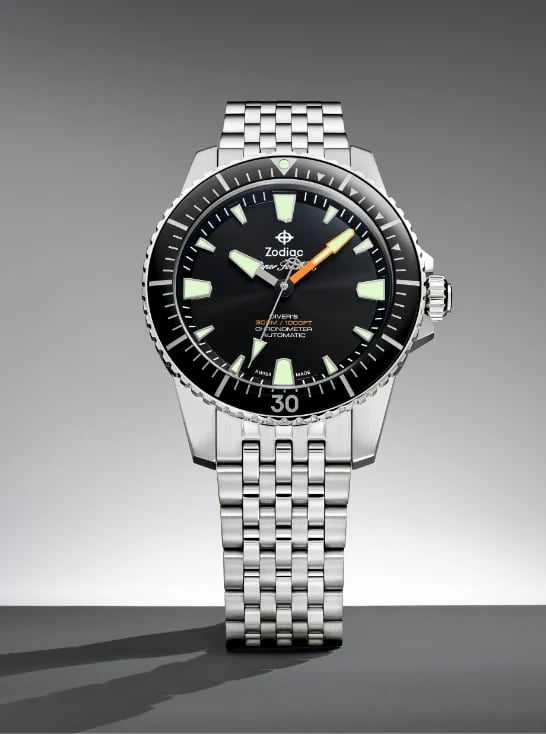
The dial is the ref. 691's strongest argument. It is matte black in the examples most collectors seek, with simple applied or painted markers and a date window at three o'clock. The design is legible without being sterile, and the patina that develops on the luminous compound gives each watch a distinct face. The lume is no longer active on most examples, which is normal for a vintage watch and part of its honesty. This is not a watch for night diving; it is a watch for daylight wear and the pleasure of owning something that has aged gracefully.
The rotating bezel is equally important. It gives the watch its tool-watch identity and provides the kind of tactile interaction that modern smartwatches cannot match. On a vintage example, check the bezel insert for fading, cracking, and replacement. A faded insert can be beautiful, but a badly replaced one can ruin the look. The same goes for the hands and crown: originality matters, but so does condition. A watch with a replaced crystal and a fresh service is still a good watch; a watch with a refinished dial and mismatched hands is a different proposition.
The ref. 691 is not a large watch by modern standards, and that is part of its charm. It sits in the vintage sweet spot where the bezel, dial, and case feel proportionate to the wrist rather than to a marketing department. The date window is small but useful, and the overall layout is clean enough to read at a glance. It is a design that has aged well because it was never trying to be fashionable in the first place.
Accuracy and service
A well-serviced Cal. 70 can be expected to run within roughly plus or minus 15 to 30 seconds per day, depending on condition, position, and the quality of the service. These are vintage tolerances; do not expect chronometer performance. Magnetization, worn pivot jewels, and a tired mainspring can all widen the spread. A recent service with a competent independent watchmaker is more valuable than a paper claim of accuracy.
Service is the practical heart of vintage ownership. The ref. 691 is not a watch you send to a boutique and forget about. It benefits from a watchmaker who understands mid-century automatics and can source or restore the right parts. Service intervals vary with use, but a vintage automatic should be checked every few years, especially if it is worn regularly. The cost of service is part of the cost of ownership, and it should be factored into the purchase price. A cheap ref. 691 with no service history is often more expensive in the long run than a well-maintained example.
Water resistance is another consideration. Vintage dive watches are not modern dive watches. Gaskets age, cases can be polished, and original water resistance is not a guarantee. If you plan to swim with a vintage ref. 691, have it pressure-tested first and accept that the answer may be no. For most owners, the watch is a daily wearer and a piece of history, not a tool for actual diving. That is not a compromise; it is part of owning a vintage object responsibly.
Variants, family, and alternatives
The ref. 691 is the core vintage Sea Wolf reference with date and rotating bezel, but examples vary in bezel insert, hand style, and luminous compound patina. Originality of dial, bezel, and crown is the key collector concern. Within the Sea Wolf family, collectors also look at references such as the 692 and 699, as well as the modern Super Sea Wolf 53. Each has its own character, but the ref. 691 remains one of the most direct expressions of the original tool-watch idea.
Zodiac's broader catalog offers other interesting paths. The Astrographic is a bold, space-age design that appeals to collectors who want something more extroverted. The Olympos is another mid-century shape with its own following. The Super Sea Wolf is the modern continuation of the dive-watch line, with contemporary materials and specifications. None of these replaces the ref. 691, but they show how consistently Zodiac has been willing to make watches with personality.
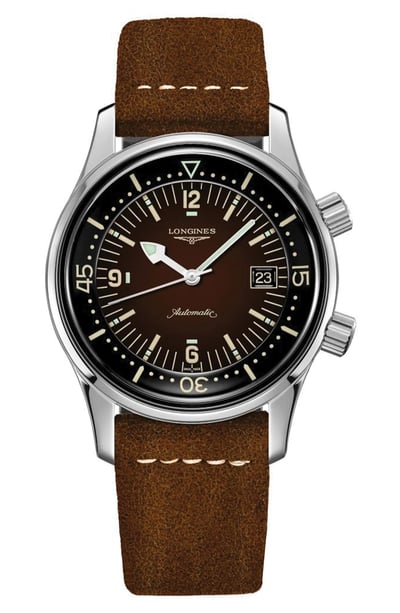
If you are comparing the ref. 691 with other watches, the obvious alternatives are vintage divers from Omega, Tudor, and Longines. A vintage Omega Seamaster 300 offers a similar mid-century mission with a date and rotating bezel. A Tudor Submariner 7928 is a contemporary tool diver with comparable vintage appeal and honest engineering. The Longines Legend Diver is a modern reinterpretation of the vintage compressor-style diver aesthetic. Each has its own strengths, but the Zodiac is often the more affordable way into genuine vintage dive-watch ownership.
For buyers who want the look without the vintage responsibilities, homages exist. The Dan Henry 1970 Automatic Diver is a vintage-inspired compressor-style diver that echoes the Sea Wolf's mid-century spirit at an accessible price. It is not a substitute for the real thing, but it is a useful reminder that the design language of the ref. 691 still resonates. The homage can be a daily beater; the Zodiac can be the watch you wear when you want the real thing on your wrist.
Market and value
The ref. 691 is not a major auction watch. There is no long history of record-breaking prices, and that is part of its appeal. Well-preserved examples trade in the low four figures, with condition, originality, and service history driving the spread. The market is stable rather than speculative. You are not buying a financial instrument; you are buying a piece of mid-century design that happens to be a watch.
The price range of roughly $1,000 to $2,500 reflects the wide variation in condition. A watch with a clean dial, original bezel, correct hands, and a recent service will sit at the top of that range. A watch with a replacement dial, mismatched hands, or an unknown service history should be priced accordingly. The ref. 691 is not rare in the way that a limited-edition modern watch is rare, but good examples are becoming harder to find as collectors recognize the value of honest vintage tool watches.
From an investment perspective, the ref. 691 is best viewed as a stable enthusiast asset. It is unlikely to appreciate dramatically, but it is also unlikely to collapse. The real return is in wearability and satisfaction. If you buy a good example, service it properly, and keep the original parts, you will have a watch that holds its value reasonably well and gives you something more valuable than a spreadsheet: a connection to the golden age of mechanical dive watches.
Final verdict
The Zodiac ref. 691 is not a modern luxury watch, and that is precisely its charm. It offers the essentials of a mid-century diver — date, rotating bezel, automatic movement — in a package that feels personal rather than precious. Buy a good one, service it properly, and wear it often. It will not impress everyone, but it will reward the person who understands why a vintage tool watch can be more satisfying than a modern status symbol.
In a market full of reissues and oversized divers, the ref. 691 remains a quiet original. It is honest about what it is: a stainless steel Sea Wolf with a date, an acrylic crystal, and a movement that has earned its patina. For the discerning young collector, that is enough. It is a watch to wear, to learn from, and to keep.