A dive watch with a passport
Most travel watches ask you to pick a camp. You can have a rotating 24-hour bezel that clicks around under your thumb, or a printed city ring you read like a railway timetable, but rarely both in one case — and almost never in a case with a dive-watch pedigree. Zodiac's Super Sea Wolf GMT World Time walks into that gap with a ring of city names around the dial, a 24-hour scale, and a fourth hand doing the arithmetic. It is a slightly odd idea. After eight days on my wrist, I think it is a good one.
I wore it for a transatlantic flight, three days of desk work, a weekend of swimming in cold water, and one dinner where I was the only person at the table who cared what was on my wrist. That is the test that matters. A watch like this either disappears into your life or it nags at you, and the difference rarely shows up in a specification sheet.
The case, and what eight days did to my wrist
The first thing you notice is not the complication. It is how quickly the watch disappears. Zodiac has kept the case compact relative to the dial, and the lugs curve down hard enough that the bracelet meets the wrist rather than hovering over it. There is no gap under the lugs on my wrist — the usual reason a mid-size diver ends up in a drawer — and the caseback sits flat against bone without rocking. The case profile is restrained enough that the watch reads as a Sea Wolf first and a travel watch second, which I suspect is exactly the intent.
Weight is the other surprise. A steel bracelet with solid links at this price point usually announces itself with a metallic heft that becomes tiresome by Thursday. This one is balanced: the case is the heaviest element, the bracelet is a supporting act rather than the main event, and the clasp does not drag the whole assembly down toward the six o'clock side. I wore it through a warm day in a shirt cuff and forgot it was there, which is the highest compliment I can pay a watch that is not a dress watch.
The compromise is height. A complication stacked onto a dive-watch architecture has to live somewhere, and here it lives in the case's depth. It never caught a cuff, but you are aware of it when you pull a jacket on. On the rubber strap the balance shifts — the head becomes the whole watch, which I found more noticeable in the water and less noticeable at a desk. Neither configuration is wrong; they simply suit different weeks.
Reading the world at thirty centimetres
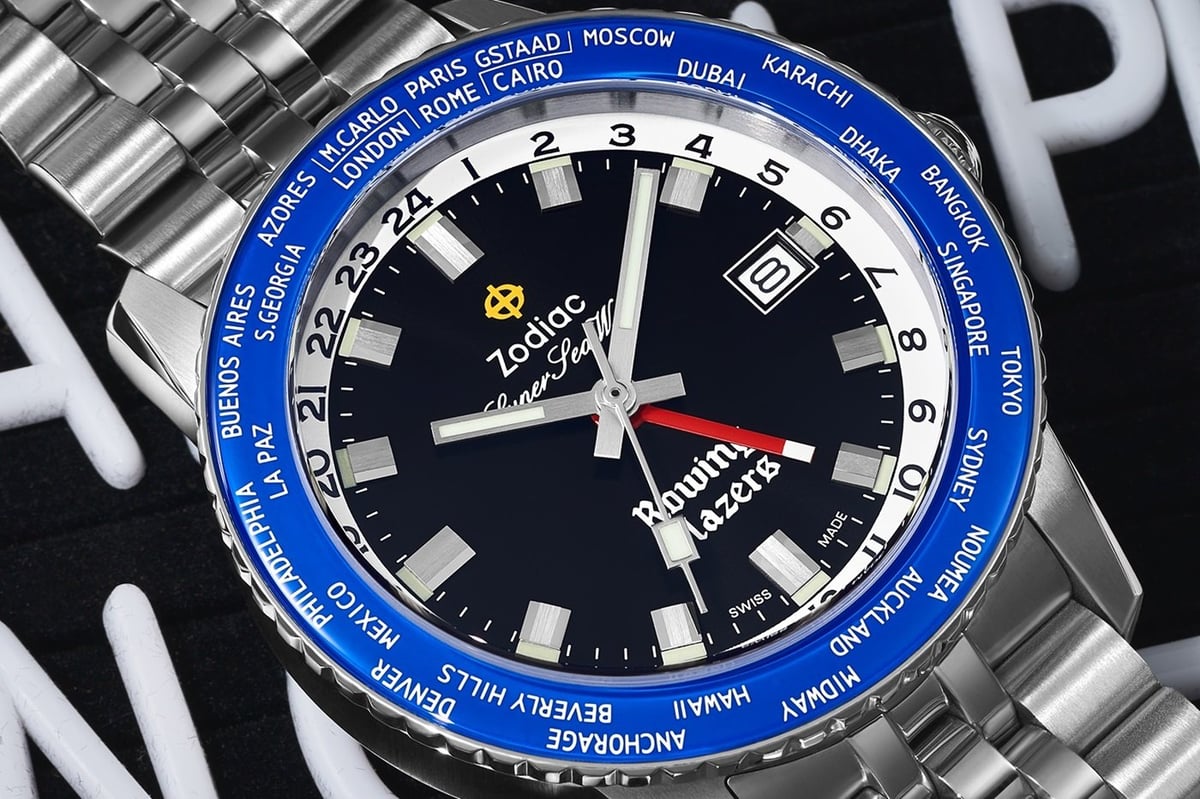
The World Time layout is the reason to buy this watch, so it deserves a fair trial rather than a paragraph of admiration. Around the outer edge of the dial runs a ring of city names. Inside it sits a 24-hour scale, and sweeping over both is a fourth hand tracking a second time zone. Set your local time, align the city ring to the hour, and the rest of the world resolves itself without arithmetic.
In daylight, at arm's length, it works. I set the watch in Paris and read Auckland without thinking twice, which is the whole point. The print is fine — genuinely fine, not figuratively — and Zodiac has resisted the temptation to make the city ring the loudest thing on the dial. The hour markers and hands keep their authority, so you can still read the time in a hurry without parsing the geography first. That balance is harder to achieve than it looks, and plenty of world timers fail it by treating the complication as the headline act and the actual time as an afterthought.
At night it is a different watch. The lume is generous on the markers and hands and effectively absent on the city ring, which means the travel function becomes a daylight-only tool. That is a real limitation, and it is the sort of thing that looks trivial in a specification list and becomes irritating on a red-eye flight. If you plan to use the World Time function at three in the morning in a dark hotel room, you will be reaching for your phone. The primary read, at least, is excellent after dark.
Legibility of local time is very good in any light. Broad hands, applied markers, minimal clutter where it matters. The date window is small enough to be discreet and large enough to be useful, and the dial's finishing keeps reflections under control without the dead-matte flatness some tool watches use as a shortcut. The crystal stays clean under a sleeve; the anti-reflective treatment is present but not so aggressive that the dial goes grey at an angle.
The engine, and what it does when you are not looking
Inside is an STP automatic — Swiss Technology Production, the movement manufacture that sits within Fossil Group alongside Zodiac. That provenance cuts both ways. On one hand, this is not an in-house caliber, and collectors who care about that will care. On the other, STP builds a proven, widely serviced architecture, which means ownership does not come with a year-long wait for a component or a service bill that requires a second mortgage. For a watch designed to be worn in salt water and thrown in a carry-on, serviceability is not a footnote. It is a feature.
Finishing is honest rather than beautiful: rhodium-plated bridges, minimal decoration, exactly what you would expect under a closed caseback. The movement beats at 4 Hz, giving the seconds hand a smooth-enough sweep, and the winding feel through the crown is positive without being gritty. The crown screws down with a satisfying final quarter-turn that tells you it is seated.
Accuracy is where a non-certified caliber shows its character. Zodiac does not submit this movement to COSC, so you are buying a tolerance rather than a guarantee. In practice, expect a few seconds a day either side of zero, with variation driven by how you wear it — mine gained slightly on office days and lost a little when I was moving constantly. Over a week I reset it once, and only because I crossed four time zones, not because it had drifted. If you need single-digit consistency without thinking about it, buy certified. If you accept that a mechanical watch is a small machine with opinions, this sits comfortably inside what a Swiss automatic at this price should deliver.
Living with it
The bracelet is the quiet hero. Solid links, a brushed finish that hides hairlines, and a clasp flush enough that I never once thought about it while typing. The deployant takes a moment to learn and then becomes second nature; the usual complaint about clasps that sit too tall does not apply here. If you are the sort of person who swaps straps weekly, the curved-end fitting will frustrate you. If you are the sort who finds one good strap and stops, this is fine.
The rubber option changes the watch's personality entirely: more tool, less office, and noticeably better in salt water because there is nothing to rinse out of the links. I swam in both. The bracelet version dried quickly and did not trap grit, but the rubber version is the one I would take on a dive trip. The case is rated for diving, and the screw-down crown and caseback make that a practical claim rather than a marketing one.
Scratches will come. The polished case flanks pick up hairlines the way any polished steel does, and after a week there were two faint marks near the lugs from a seatbelt. I stopped minding by day three, which is the correct response in a watch meant to travel. The bezel-area edges are crisp enough that you will notice if you clip a door frame; there is no soft cushioning in this design language.
Where it surprised me most was in the mundane hours. On a plane it was useful. At a desk it was quiet. In the water it was unremarkable in the best sense — no fuss, no strap slip, no need to think about it. The watches I end up keeping are almost always the ones I stop noticing.
Value, alternatives, and who should buy it
At the roughly two-thousand-dollar mark on the street, the Super Sea Wolf GMT World Time competes with some genuinely excellent watches: the Tudor Black Bay GMT above it, the Longines Spirit Zulu Time alongside it, the Christopher Ward and Baltic options below. Its argument is not finishing per dollar — Longines wins that — and it is not heritage, which Tudor owns outright. Its argument is the combination: a true world-time display in a case you can swim in, from a brand with a real dive-watch lineage, at a price that does not require a family meeting.
Resale is the weak spot. Zodiac's modern catalogue trades at a consistent discount on the secondary market, and this model is no exception; assume you will lose a meaningful slice of retail the day you walk out of the boutique. That is not a reason to avoid the watch. It is a reason to buy it pre-owned, or to buy it new and wear it hard enough to earn the depreciation. This is not a piece to keep in a box and check on quarterly.
Buy it if you travel, swim, and want one watch that handles both without looking like a dashboard instrument. Buy it if the idea of reading Auckland off your wrist appeals to you more than the idea of a rotating bezel you click twice a year. Do not buy it if you need night-time access to the world-time function, if you want certified accuracy, or if resale value is part of your definition of a good purchase. Those are real trade-offs, and Zodiac has made them deliberately rather than accidentally.
The verdict
The Super Sea Wolf GMT World Time is the rare complication watch that gets better the less you think about it. It swims, it travels, it disappears under a cuff, and it reads the time in Auckland without a phone. The unlit city ring and soft resale keep it from being a universal recommendation, but if you want one watch that handles a flight and a shoreline without changing personality, this is a genuinely persuasive answer — and one of the few world timers that remembers it is a dive watch first.